Q. Write a short note on: Birsa Munda Movement. [71st BPSC, 2026]
Ans:
The Birsa Munda Movement, historically known as the Munda Ulgulan (The Great Tumult) of 1899–1900, was one of the most organized, intense, and socio-politically significant tribal uprisings against British colonial rule in the Chhotanagpur plateau region (present-day Jharkhand). Led by Bhagwan Birsa Munda (1875–1900), a charismatic youth from Ulihatu in Khunti district, the rebellion uniquely synthesized internal socio-religious reform with radical anti-colonial political resistance.
Rallying under the famous slogan, “Abua Raj Setarjana, Maharani Raj Tundujana” (“Let the kingdom of the queen be ended and our kingdom be established”), the movement aimed to overthrow alien colonial authority and establish an independent self-governing Birsa Raj.
Causes of the Movement
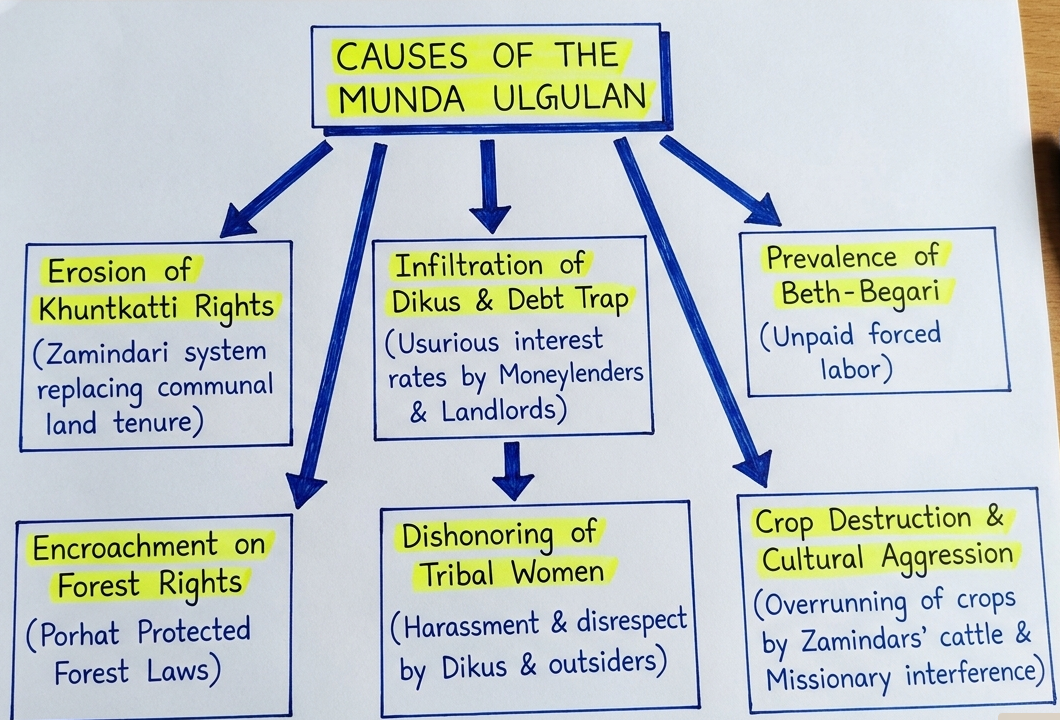
- Infiltration and Exploitation by Dikus: Non-tribal outsiders (Dikus)—comprising zamindars, traders, thikadars, and moneylenders—penetrated the region, usurped tribal lands through corrupt credit practices, and reduced native Mundas to a landless, slave-like existence.
- Forced Labour (Beth-Begari): Tribals were subjected to widespread Beth-Begari (unpaid compulsory labour) enforced by landlords and colonial agents.
- Alienation of Forest Rights: Unjust forest regulations (such as those enforced in the Porhat protected forests) stripped the tribals of their customary rights over forest produce and village wasteland.
- Socio-Cultural & Religious Disruption: Aggressive proselytization by Christian missionaries and exactions by church authorities created deep anxiety regarding the loss of traditional tribal identity and cultural heritage.
- Forced abduction and dishonoring of tribal women.
Dual Nature of the Movement
- Internal Purification & Religious Revivalism (The Birsait Sect)
- Socio-Religious Reform: Birsa Munda began his mission by reforming tribal society from within. He founded the Birsait sect, advocating strict monotheism—worship of a single God, Singbonga (the Sun God).
- Moral Code: He urged followers to abandon alcohol, give up belief in witchcraft and irrational rituals, maintain personal hygiene, and reconnect with their cultural roots.
- Messianic Leadership: Birsa claimed to have received a divine vision, declaring himself a prophet (Dharti Aaba or Father of the Earth) endowed with miraculous healing powers.
- His spiritual leadership forged strong inter-tribal solidarity across the Munda, Oraon, and Kharia communities.
- Anti-Colonial Political & Armed Struggle (Ulgulan)
- Rejection of Colonial Authority: By 1895, Birsa turned his religious followers into a political movement, instructing Mundas to stop paying rent to zamindars and deny British legal jurisdiction.
- Armed Mobilization: He organized two distinct units—one for propaganda and another for armed guerrilla warfare.
- In December 1899, the Birsaits launched a well-orchestrated offensive across Ranchi, Khunti, Tamar, Sarwada, and Bandgaon, attacking police stations, government offices, zamindar property, and Christian missions using poisoned arrows, spears, and traditional weapons.
Suppression and Significant Outcomes
- The British administration deployed the military to crush the uprising with superior firepower . Birsa Munda was arrested in February 1900 and died of cholera in Ranchi Jail on June 9, 1900, at the age of 25.
- The movement compelled colonial authorities to reform tribal land administration. The historic Chotanagpur Tenancy (CNT) Act, 1908 was passed, legally recognizing Khuntkatti rights and strictly banning the transfer of tribal land to non-tribals.
- The government officially banned the oppressive Beth-Begari system.
- Khunti was made a separate administrative sub-division in 1905 to ensure closer government oversight and grievance redressal.
The Birsa Munda Movement marked a milestone in India’s subaltern freedom struggle, proving that tribal resistance was not merely a localized law-and-order issue but an organized anti-feudal and anti-colonial revolution. Birsa Munda’s extraordinary leadership earned him a permanent place in national memory; he remains the only tribal leader whose portrait is hung in the Central Hall of the Parliament of India.
To honor his enduring contribution to national liberation and tribal empowerment, November 15 (his birth anniversary) is officially celebrated across the nation as Janjatiya Gaurav Divas (Tribal Pride Day).