Q. Analyse the major feature of Mauryan art and architecture, and assess how far they expressed the political and cultural values of the period.[71st BPSC, 2026]
Q. Analyse the major feature of Mauryan art and architecture, and assess how far they expressed the political and cultural values of the period.[71st BPSC, 2026]
Ans:
Mauryans were the earliest empire builders who ruled over a vast geographical area. Strong political base, centralized administrative system and favourable economic as well as other environmental conditions provided surplus production which led not only to urbanization but also paved the way for renaissance in the field of art and culture.
After an interregnum of more than a thousand years, since the demise of the Indus Valley Civilization, which had plenary command over stone cutting and sculpting, there was the revival of sculptural art during Mauryan period. And there was transition from use of wood to stone.
Mauryan Art basically flourished under the royal patronage. But, side by side, folk art was also well developed during Mauryan period. It would bebetter to study Mauryan Art by dividing it into two parts: (1) Court Art and (2)Folk Art.Court Art:
Palace–
The 80 Pillared Hall discovered at Kumhrar (Patna) is supposed to be the site of Mauryan Palace.
The city of Patliputra was wooden fortified.
In the words of Megasthenese “….. the city formed a Parallelogram, nine miles by one and half miles surronded by a ditch, 200 yards wide, and protected by a timber palisade with Loop holes for the archers. The palisade was reinforced by 570 towers and had 64 gateways…. “
Greek historian, Megasthenes, described the palaces of the Mauryan empire as one of the greatest creations of mankind and Chinese traveler Fa Hien called Mauryan palaces as god gifted monuments.
Pillars:
The Mauryan Pillars are of two types:
Attached to hall: e.g. pillars of 80 pillar hall at Kumhrar.
Pillars here are without any capital;
Independent or free standing pillars of Ashoka. This in turn is of two types:
One with animal capitals and
second without any capital.
Free standing pillars are symbol of political power and authority. And the Objective wasto disseminate theBuddhist ideology and court orders in the entire Mauryan empire.
Distribution:
Pillars found in Bihar at 4 places:
Kolhua (Vaishalli)- with lion capital but without any inscription.
This is the largest pillar of all Mauryan pillars.
Lauriya Areraj– Pillar is without any animal capital but with inscription. It is one of the first six pillar edict of Ashoka in early Brahmi character,
Lauriya Nandangarh-with Lion Capital
Rampurva– Here, two pillars with lion capital and Bull Capital have been found.
Ashokan Pillars have been found at other places like Merrut, Topra (Delhi), Allahabad, Sankisa, Sanchi, Sarnath, Lumbini, Nigalisagar, Basarh and Kosam.
Features:
Usually made of Buffgray coloured sandstone from Chunar region (near Banaras). Some are also made up of Spotted red and white sandstone from Mathura region.
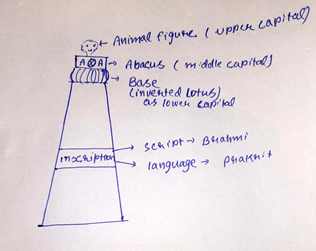
Language: While most Ashoka pillar edicts were in Pali and Prakrit language, few were written in Greek or Aramaic language also.
Mauryan pillars mainly comprise of four parts:
Shaft: A long shaft formed the base and was made up of a single piece of stone or monolith.
Lower capital: On top of shaft lay the inverted lotus-shaped or inverted bell-shaped.
Middle capital (Abacus):
a circular or rectangular or circular base.
It has engravings on sides. These engravings are animal figures or floral designs.
Spoked wheels are engraved in Sarnath and Sanchi pillar.
Capital Figure:
All the capital figures (usually animals like a bull, lion, elephant, etc) are vigorous and carved standing on a square or circular abacus.
Four Lion capital: at Sanchi and Sarnath.
Single Bull: at Rampurva.
Single elephant: Sankissa.
Technique: Polished by Agate burnishing technology.
No base.
Circular in shape.
Upper side in narrowed i.e. Tapers above.
Made of one piece of Stone. i.e. Monolithic.
No ornamentation i.e. plain.
Sarnath Pillar was constructed to mark the Buddha turning the wheel of law.
Ashokan pillars represents victory in terms of Dhammavijaya.
Similarities with Persian (Achamenian) Pillars
Polished Stones and Motifs: Both Maurya and Achaemenian pillars, used polished stones and have certain common sculpture motifs such as the lotus.
Proclamations: Maurya’s idea of inscribing proclamations (related to Buddhist teachings and court orders) on pillars has its origin in Persian pillars.
Third Person: Inscriptions of both empires begin in the third person and then move to the first person.
Both made of stone.
Both has animal figures as capital.
“80 pillar hall” at Kumhrar has mane similarities with “Hall of 100 pillars” built by Drius in his capital Petropolish.
Scholars like D.B. Spooner and Ananda K. Coomaraswamy support the view that Mauryan pillars were prototype of Achaemeniam Columns:
Before 300 BC, such stone tradition was absent in India. They have attributed the sudden emergence of such tradition to Achaemenian influence.
Iran and India had cultural contacts. Darius had conquered north-western part of India which established closer relation.
Some Ashokan Pillars employing Kharosthi script and Aramic language further strengthen such views.
Dissimilarities with Achaemanian Pillars:
Another historian Niharranjan Ray questioned the above views about Achaemanian influence.
The Capital Figure: It was absent in Mauryan pillars of the Kumhrar hall whereas pillars at Persepolis have the elaborate capital figures.
Capitals of Achaemenian pillar have two animals seating back to back. While That of Ashokan pillars have 4 animals or 1 animal .
Unicorn and inverted cup as capital in Achaemenian pillars but not in Mauryan pillar. Similarly. Elephant in Mauryan pillar but not in Achaemenian pillar.
No abacus in Achaemenian pillars.
The Shape and Ornamentation: The shape of Mauryan lotus is different from the Persian pillar.
Pillar Surface: Most of the Persian pillars have a fluted/ ridged surface while the Mauryan pillars have a smooth surface.
Architectural Scheme: The Achaemenid pillars were generally part of some larger architectural scheme, and bit complex and complicated, while the Ashokan pillars were simple and independent freestanding monuments.
Shaft: Unlike Mauryan shafts which are built of monolith (single piece of stone), Persian/Achaemenian shafts were built of separate segments of stones (aggregated one above the other).
Achaemenian pillars has base (inverted lotus shaped) but Ashokan pillar doesn’t have.
Achaemenian pillars represents victory in military terms. While Ashokan pillars represents victory in terms of Dhammavijaya.
Also the sudden emergence of this kind of stone tradition is explained in the light of growth of empire and imperial taste.
Stupas:
Stupa is a burial mounds covered with a structure in hemispherical shape. These are solid dome generally made up of bricks or stone.
After the depart (Maha Parinirvan) of Lord Buddha, his physical remains were divided into eight parts and stupas were built over it. Pre Mauryan Stupas were built on metal; of the eight stupas, remains of on Piparwaha stupa is found.
However, stupa were really built during Ashokas reign. It is said that he got built over 84000 stupas.
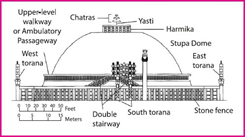
Architecture: Stupas consist of a cylindrical drum with a circular anda and a harmika and a chhatra on the top.
Anda: Hemispherical mound symbolic of the mound of dirt used to cover Buddha’s remains (in many stupas actual relics were used).
Harmika: Square railing on top of the mound.
Chhatra: Central pillar supporting a triple umbrella form.
Vedika: Railing all round. it was build of stone and was sparkingly polished.
Torana: entry gateways at four sides.
Material Used:
The core of the stupa was made of unburnt brick while the outer surface was made by using burnt bricks, which were then covered with a thick layer of plaster and medhi and the toran were decorated with wooden sculptures.
Whole structure itself was a place of worship.
Vedika and Torana has beautiful engravings in Stambha and Ushanisha related to folk symbols and Buddhist symbols.
Examples:
Mahastupa Sanchi by Ashoka. (later developed during Shunga period)
Dharmarajjika stupa at Sarnath by Ashoka.
Cave Architecture:
Cave architecture started during Maurya by cutting rocks of hills.
Though excavated in hard granite rocks. Interior walls are polished like glass.
During the Mauryan period, caves were generally used as viharas, i.e. living quarters, by the Jain and Buddhist monks.
These caves were built by Ashoka and his grandson Dasarath for residing Ajivakas.
Examples:
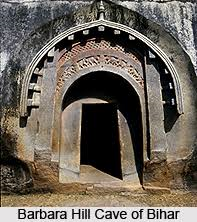
In Gaya, three caves on Nagarjuni hills and four caves on Barbara hills can be seen. Sudama cave, Karna Chaupra cave, Lomesh Rishi cave (most famous).
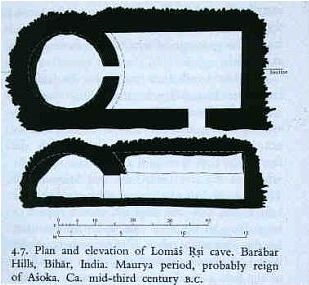
The gateways of Lomash rishi cave at Barabar hills has ornamented arched entrance.
Shape of Cave: two chamber-> one circular and other rectangular.
Sculpture:
Mauryan Sculpture includes both court and folk art. The sculptures are made of stone, metal and clay.
Court sculpture:
Stone sculptures are found in three forms by cutting stone, engraved or independently made on monolithic pillar and independently made sculptures.
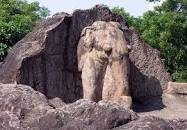
Elephant made by cutting Dhauli stone of Orrisa shows the excellence of stone sculpture. The Elephant appears quite natural and ready to come out of stone.
Likewise, on Kalsi (Dehradun) stone, an image of elephant is found engraved.
Both the images of elephant present the perfect example of the excellence achieved in the field of stone sculptures.
Sculpture built upon the monolithic Pillar has already been discussed.
Metal sculptures has been mentioned by Kautilya.
Folk Sculpture:
Independently made sculptures are found mostly in folk art.
Clay made sculpture are found largely in folk art.
Folk Art:
Folk Art was developed by independent artisans without any royal patronage.
Examples:
Yaksh idol found at Parkham village of Mathura district. Also called, Manibhadra
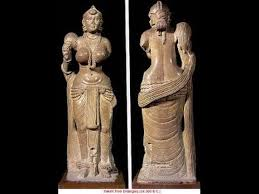
Didarganj (Patna) Yakshini Idol, which is exhibited at Patna Museum. It is made of sandstone and is polished.
A laughing boy at Bulandibag.
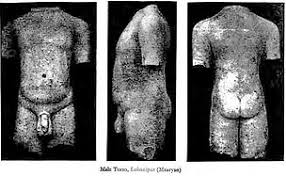
Two naked images of jaina saint found from Lohanipur (Patna)
Tri-mouth Yaksh idol found from Rajghat (Varanasi).
Above images are made of gray sandstone which are still sparkling with Mauryan polish. Their bodies are decorated with clothes and ornaments.
Pottery of the Mauryan period is generally referred to as Northern Black Polished Ware (NBPW).
Mauryan pottery was characterized by black paint and highly lustrous finish and was generally used as luxury items.
Kosambi and Patliputra were the centers of NBPW pottery.
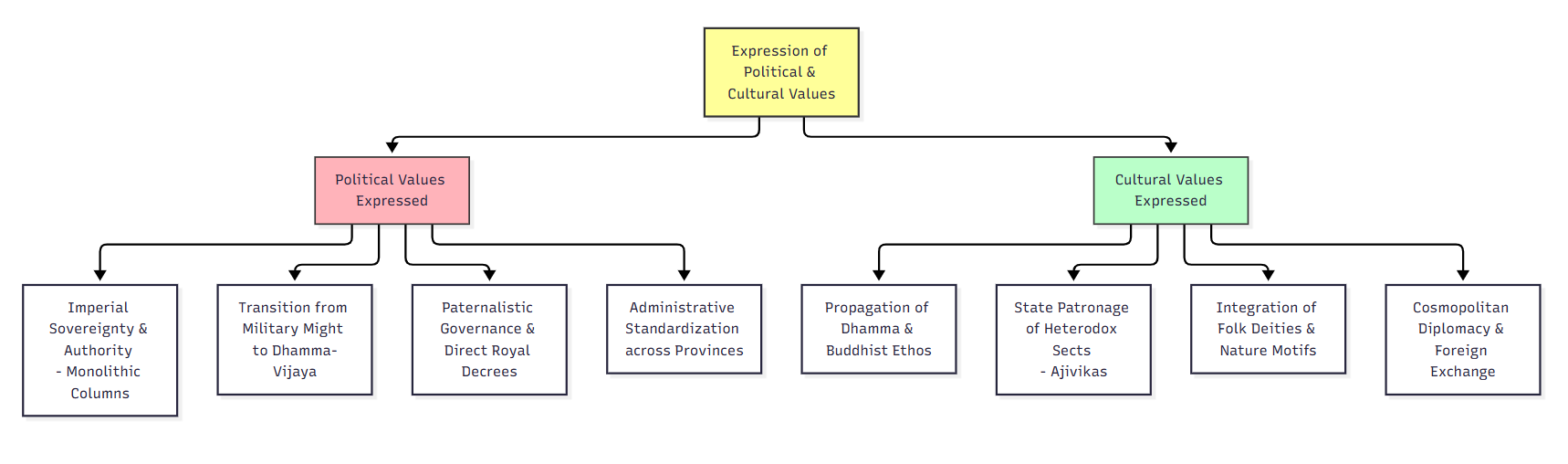
How Far Mauryan Art Expressed Political & Cultural Values
Mauryan art was not merely aesthetic; it served as a deliberate visual medium expressing the political philosophy of a pan-Indian empire and the cultural ethos of a pluralistic society.
Expression of Political Values
Visual Proclamation of Imperial Sovereignty:
Monolithic pillars erected along major trade highways and provincial capitals served as physical markers of the Emperor’s supreme jurisdiction and state power across a vast territory.
The imposing scale, uniformity of Chunar stone, and mirror-polish symbolized the administrative discipline and organizational strength of the Mauryan state.
Shift from Military Conquest to Dhamma-Vijaya:
While early Mauryan statecraft relied on military force, Ashoka transformed art into a primary instrument of Dhamma-Vijaya (Conquest through Righteousness) following the Kalinga War.
Animal capitals carried political-philosophical symbolism: the Lion represented royal authority and courage, the Bull signified steadfastness and agrarian strength, the Elephant symbolized imperial majesty, and the Wheel (Chakra) symbolized universal law (Chakravartin).
Paternalistic Statecraft & Public Accountability:
Ashokan pillars bore royal edicts written in regional vernacular scripts (Brahmi, Kharosthi, Aramaic, and Greek) and Prakrit/Pali languages.
This reflected a paternalistic philosophy of governance (“All men are my children”), making imperial laws, moral codes, and administrative reforms transparently accessible to the public.
Expression of Cultural and Spiritual Values
Promotion of Universal Ethics & Buddhist Ideology:
Stupas, pillars, and sacred relief carvings (lotus, spoked wheels) visualised the core principles of Buddhism—marking key events like Buddha’s First Sermon (Dhammacakkappavattana at Sarnath).
The edicts promoted universal moral conduct: non-violence (Ahimsa), truthfulness, obedience to parents, humane treatment of servants, and prohibition of animal sacrifice.
Institutional State Tolerance & Heterodox Patronage:
Despite Ashoka’s personal devotion to Buddhism, Mauryan court art reflected a culture of religious pluralism and state neutrality.
The dedicated donation of the Barabar and Nagarjuni rock-cut caves to the non-Buddhist Ajivika sect by Ashoka and Dasharatha demonstrates official respect for diverse heterodox philosophies. Similarly, his grandson Samrat Samprati actively patronized Jainism.
Synthesis of Folk Traditions & Nature Veneration:
The prominence of Yaksha-Yakshini statues and animal motifs (elephants, bulls, peacocks) highlights the integration of indigenous folk beliefs, nature worship, and popular fertility cults into the broader imperial cultural fabric.
Cosmopolitan Exchange & Global Diplomacy:
Architectural elements—such as stone polishing, bell capitals, and formal edict inscriptions—reflect dynamic cultural exchange with Achaemenian (Persian) and Hellenistic worlds.
However, unlike Persian pillars (which were composite shafts built inside palaces to celebrate military victories), Mauryan pillars were independent, monolithic monuments erected in public spaces to promote ethical social order.
Mauryan art and architecture achieved a seamless synthesis between imperial statecraft and philosophical humanism. By transitioning from perishable wood to enduring stone, Mauryan builders translated the political authority of an expansive empire and the spiritual ideals of Dhamma into monumental form.
The artistic legacy of the Mauryas—most famously preserved in the Sarnath Lion Capital (India’s National Emblem) and the Ashoka Chakra (centered on the National Flag)—continues to embody the foundational political and cultural values of modern India.

 Mauryan art was not merely aesthetic; it served as a deliberate visual medium expressing the political philosophy of a pan-Indian empire and the cultural ethos of a pluralistic society.
Expression of Political Values
Mauryan art was not merely aesthetic; it served as a deliberate visual medium expressing the political philosophy of a pan-Indian empire and the cultural ethos of a pluralistic society.
Expression of Political Values