Q. Write a short note on: Impact of Western Education in Bihar (1858-1914). [71st BPSC, 2026]
Ans:
The period between the Queen’s Proclamation (1858) and the outbreak of the First World War (1914) marked a crucial phase in the socio-political evolution of Bihar. Following Wood’s Despatch (1854)—often called the “Magna Carta of English Education in India”—the British administration established systematic institutional structures, replacing traditional pathshalas and madrasas with modern English-medium schools and colleges
Although primarily designed by colonial authorities to create a low-cost administrative class (“Indian in blood and colour, but English in taste and intellect”), Western education in Bihar acted as a catalyst for intellectual awakening, giving birth to a modern middle class, fostering Bihari sub-nationalism, and shaping early anti-colonial resistance.
Development & Institutional Landscape (1858–1914):
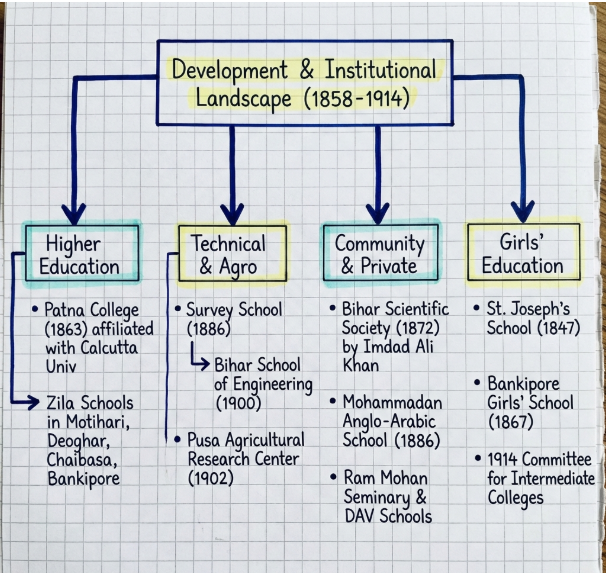
- Expansion of Higher Education: Patna College (established January 9, 1863), affiliated with Calcutta University, became the premier center of higher learning in Bihar. Zila schools were opened across districts like Deoghar, Motihari, Chaibasa, and Bankipore.
- Technical & Vocational Initiatives:
- Bihar School of Engineering (1900) evolved from the Survey Training School (1886) to impart formal degree and diploma technical education.
- Pusa Agricultural Research Centre (1902) was established with financial assistance from American philanthropist Henry Phipps to pioneer scientific farming research.
- Socio-Religious & Private Efforts:
- Aligarh Movement’s Influence: Imdad Ali Khan founded the Bihar Scientific Society in Muzaffarpur (1872) and Patna (1893) to translate scientific works into vernacular languages. The Mohammadan Educational Society founded the Mohammadan Anglo-Arabic School (1886).
- Brahmo & Arya Samaj: Established institutions like the Ram Mohan Seminary in Patna and Dayanand Anglo-Vedic (DAV) schools to synthesize modern scientific education with cultural values.
- Girls’ Education: St. Joseph’s School (1847) and Bankipore Girls’ School (1867) initiated formal female education. In 1914, the Bihar & Orissa government constituted a dedicated committee to extend female education to the intermediate level.
Impact of Western Education in Bihar:
- Rise of Bihari Sub-Nationalism & Creation of Modern Bihar (1912)
- Dominance of Bengal & Regional Discontent: As Bihar was administered as a hinterland of the Bengal Presidency, educated Biharis found themselves excluded from government jobs, judicial posts, and railways, which were heavily dominated by Bengalis.
- The “Bihar for Biharis” Movement: English-educated visionaries—such as Sachchidanand Sinha, Mahesh Narayan, and Nand Kishore Lal—voiced regional aspirations through journals like Bihar Times (1893) and The Bihari (1906).
- Statehood Realization: This intellectual movement mobilized public opinion through the Bihar Provincial Conference (1908), ultimately leading the British Crown to carve out Bihar and Orissa as a separate province in 1912. Consequently, Sachchidanand Sinha came to be remembered as the “Creator of Modern Bihar”.
- Growth of Political Consciousness & Freedom Movement:
- Infiltration of Liberal Ideas: Western education exposed youth to European concepts of liberty, democracy, rule of law, and national self-determination.
- Leadership Generation: It produced a galaxy of nationalist leaders—including Dr. Rajendra Prasad, Mazharul Haque, Braj Kishore Prasad, and Anugrah Narayan Sinha—who spearheaded mass movements in later decades.
- Influence on Tribal Resistance: Western education influenced tribal leadership as well; Birsa Munda studied at the German Mission School in Chaibasa (1886–1890), where he developed an acute understanding of colonial exploitation before launching the Munda Ulgulan.
- Rise of Modern Press & Public Associations:
- Journalistic Growth: Modern education stimulated the growth of nationalist press across languages.
- English: Bihar Herald (1875) by Guru Prasad Sen, The Searchlight (1918).
- Hindi: Bihar Bandhu (1874) and Sarbhitasi (1890).
- Urdu: Nurul Anwar and Sada-e-Aam.
- Civic Platforms: Associations such as the Patna Peoples Association and Bhagalpur National Improvement Association emerged as discussion hubs for civil rights and constitutional reforms.
- Journalistic Growth: Modern education stimulated the growth of nationalist press across languages.
- Social Reform & Questioning Traditional Dogmas
- Educated Biharis began critically evaluating social evils such as caste rigidity, untouchability, purdah system, and child marriage through the lens of rationalism and utility.
Major Limitations & Colonial Shortcomings
- Neglect of Mass Education: Under colonial policies, elementary education was neglected, keeping illiteracy high (over 84% in 1911) and creating a wide cultural gulf between the English-speaking urban elite and the rural peasantry.
- Elitist Character: High tuition fees restricted access to affluent upper/middle-caste families, reinforcing social hierarchies.
- Neglect of Technical Skills & Vernaculars: Education remained predominantly literary rather than industrial, generating a large pool of clerical job-seekers rather than skilled technical innovators.
The introduction and growth of Western education in Bihar between 1858 and 1914 was a double-edged process. While the British intended to construct an administrative mechanism for colonial governance, the unintended outcome was the awakening of political self-reliance. By nurturing a critically conscious intelligentsia, stimulating the press, and instilling regional pride, Western education successfully laid the constitutional and socio-political foundation for the emergence of Modern Bihar in 1912 and its subsequent role in India’s freedom struggle.